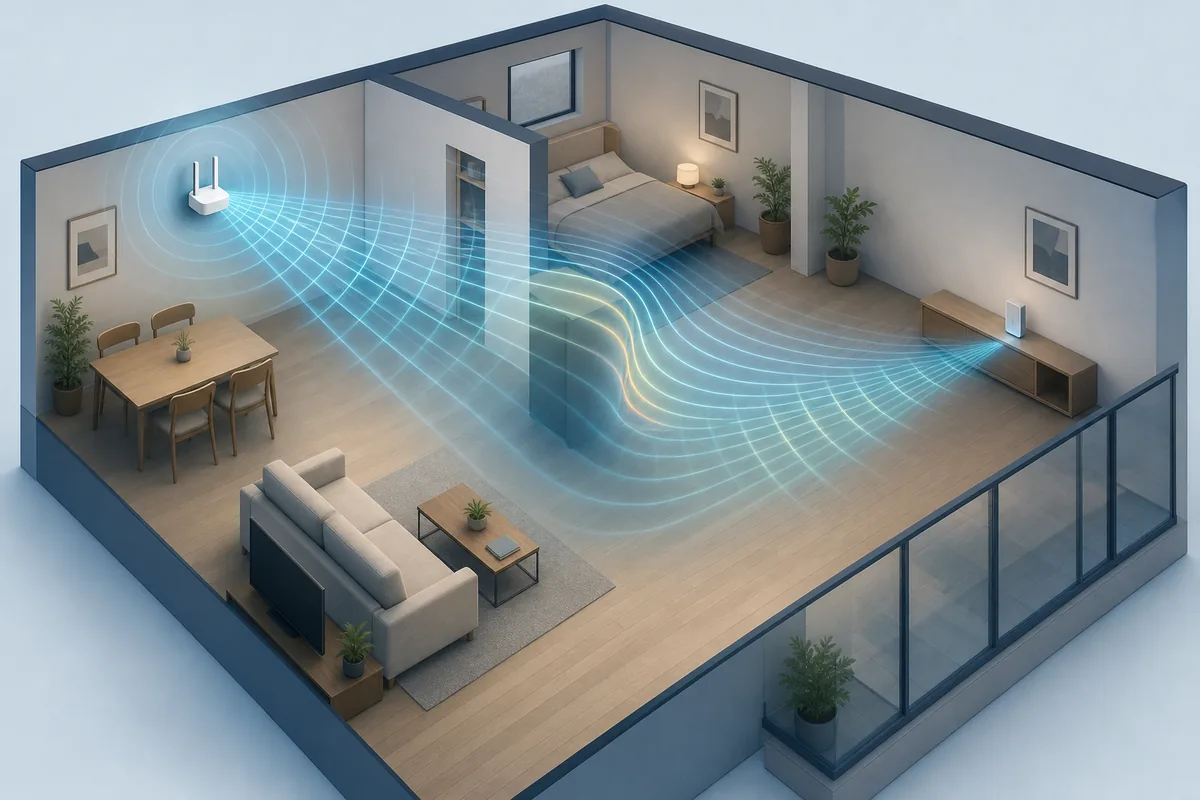
WiFi presence detection estimates whether a person is in a monitored area by measuring how the wireless channel changes. It is narrower than human activity recognition: the first useful output is occupied or empty, not identity, pose, or a medical conclusion.
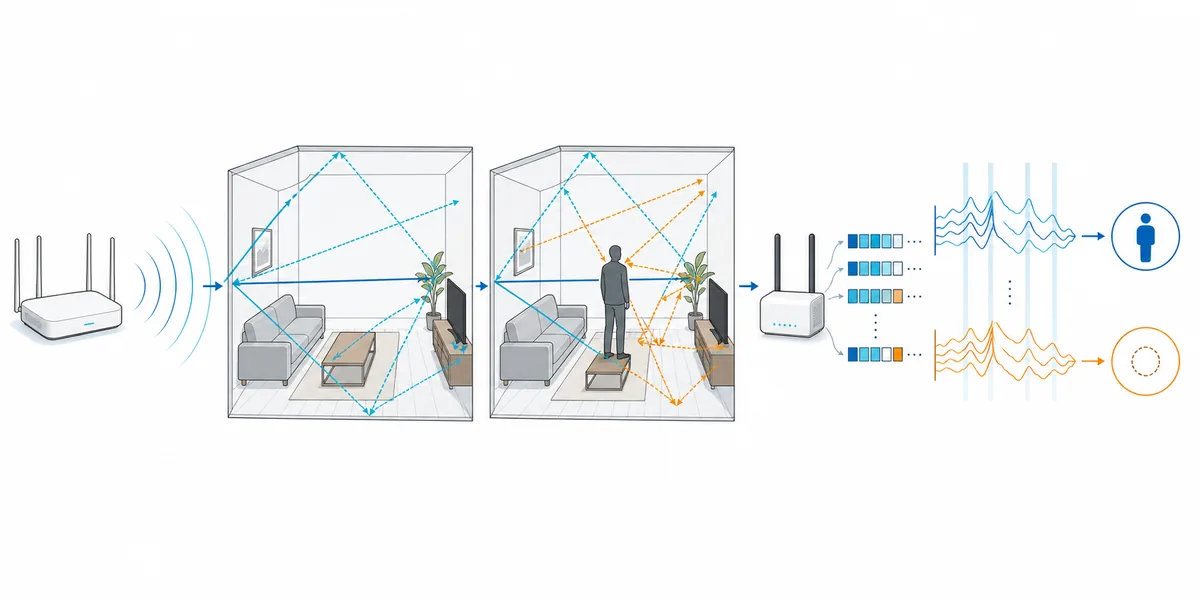
Channel State Information, or CSI, provides richer measurements than a single RSSI value. With suitable hardware, repeated samples, a defined room, and independent validation, CSI can expose multipath changes caused by a stationary or moving person.
What WiFi presence detection can and cannot tell you
A presence detector answers a bounded question: does the current signal pattern look more like the calibrated occupied state or the empty state? That can support room automation, energy management, and privacy-aware occupancy research. It cannot reliably identify a person, reconstruct a photograph, prove that someone is safe, or replace a certified security, medical, or life-safety sensor. Breathing, fall, and through-wall claims need separate datasets and stricter validation.
- Good fit: occupied-versus-empty experiments in a known room
- Possible extension: coarse motion or zone changes after baseline accuracy is stable
- Poor fit: identity, diagnosis, emergency response, or covert monitoring
How CSI turns room changes into a presence signal
Indoor WiFi reaches a receiver through paths reflected by walls, floors, furniture, and people. A person changes amplitude and phase across subcarriers. CSI records those measurements packet by packet as a time series. A defensible pipeline checks timestamps and missing packets, removes invalid samples, extracts features, and applies a threshold or classifier. The model should learn the actual room and hardware instead of assuming one universal signature.
- Keep transmitter, receiver, channel, bandwidth, and placement consistent
- Preserve timestamps, RSSI, packet metadata, and CSI dimensions
- Split training and validation by session to prevent leakage
Hardware, data, and task boundaries
Many consumer routers expose RSSI but not application-accessible CSI. Common research paths include supported ESP32 devices with ESP-IDF CSI callbacks, Broadcom hardware with Nexmon CSI, or commercial sensing platforms. Collect empty and occupied sessions on different days and positions. Include negative examples such as moving curtains, fans, doors, pets, and neighboring activity; more packets do not replace varied conditions.
| Task | Typical output | Main risk |
|---|---|---|
| Presence detection | Occupied / empty | Environmental drift looks like a person |
| Motion detection | Movement / quiet | Stationary occupant is missed |
| Activity recognition | Walking, sitting, falling | Overfitting to room or participants |
A practical WiFi presence detection workflow
Lock the room, WiFi channel, device positions, and capture settings. Record multiple empty and occupied sessions, then inspect packet cadence and missing data before calculating features. A transparent baseline is better than a complex model trained on unreliable samples. Choose a decision threshold with validation data. Test quiet sitting, doorway movement, furniture changes, and different people. Record false-positive and false-negative rates instead of showing only a successful demo.
- Compare an empty-room reference with several occupied sessions
- Repeat tests after time, placement, and environmental changes
- Use an unknown state when confidence is low
Accuracy limits, privacy, and responsible use
Channel changes, power control, furniture, doors, fans, pets, appliances, and nearby rooms can create false positives. A still person can be harder to detect than someone walking. Report performance by condition and session, not one headline accuracy number. Camera-free does not mean privacy-free. Occupancy patterns reveal routines and absence. Prefer local processing, short retention, consent, visible controls, and a non-sensing fallback. Do not use an experimental model for medical, emergency, policing, or hidden-surveillance decisions.
- Recalibrate after hardware, channel, or layout changes
- Monitor packet loss and signal drift before trusting output
- Collect only the channel data required for the stated purpose
Technical sources and further reading
WiFi presence detection FAQ
Can WiFi detect a person who is not moving?
Sometimes, but stationary presence is harder than motion and needs compatible hardware, stable packets, room-specific data, and independent sessions.
Does every WiFi router support presence detection?
No. Many consumer routers do not expose CSI. Research setups commonly use supported ESP32, Nexmon-compatible Broadcom hardware, or a dedicated platform.
Is presence detection the same as a motion sensor?
No. Motion sensing detects change, while presence sensing aims to remain positive when an occupant becomes still.
Can it see through walls?
WiFi crosses some materials, but presence detection does not create a visual image. Results depend on wall material, distance, geometry, hardware, and calibration.